Financial statement analysis built for credit decisioning.
SCREDIT helps analysts and credit leaders turn financial statements into structured, underwriting-ready insight with ratio visibility, trend analysis, and more consistent review workflows.
What is financial statement analysis for trade credit?
Financial statement analysis for trade credit is the review of a customer's balance sheet, income statement and cash flow to judge whether they can pay. It converts submitted statements into comparable ratios and trends covering liquidity, leverage, coverage and working capital, so applicants of different sizes are assessed on the same basis.
Manual financial review slows strong credit decisions.
Financial statement analysis is one of the highest-value activities in underwriting, yet many teams still rely on manual spreading and inconsistent review patterns. SCREDIT helps structure that work for greater speed and consistency.
What SCREDIT delivers
Capture Without Leaving the File
Set up, capture, and review a statement from inside the application you are working on. No separate spreading tool, no navigating away and losing your place.
Spread From What You Were Sent
Upload the statement as a spreadsheet, a CSV, or a scan. Line items are extracted and mapped to standard metrics, then put in front of an analyst to confirm before anything is committed.
Derived Figures, Not Re-Keyed Ones
Operating expense, EBIT, EBITDA, pre-tax and net income are computed from the statement rather than retyped, so a transposition in one cell does not quietly move a ratio.
Banded Against the Right Industry
A quick ratio that is healthy for a distributor is thin for a contractor. Ratios band against a baseline you set, with industry-specific overrides layered on top, so the same number is not judged the same way everywhere.
Anomalies Surfaced for Review
Figures that do not sit right against the rest of the statement are flagged for an analyst to look at, rather than passing silently into a score.
Period Over Period
Statements are held by period, so the question is not only what the ratios are but which direction they have been moving.
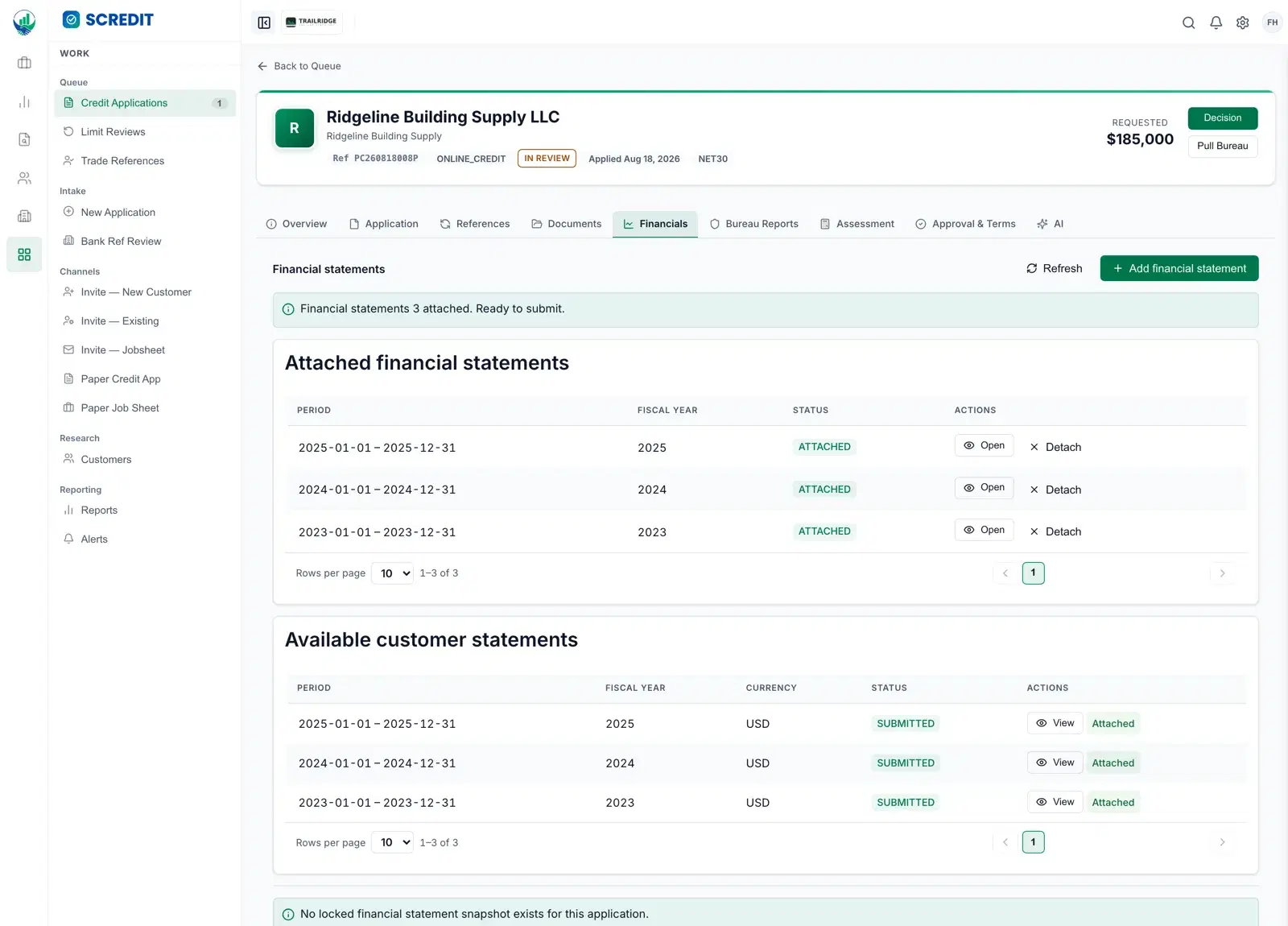
Statements, in the product
What changes on the desk
Analysts Review, Not Retype
The time goes into judging the numbers instead of transcribing them.
The Same Statement Reads the Same Way Twice
Two analysts, one set of figures, one set of ratios — computed, not hand-built.
Ratios That Mean Something in Context
Industry-aware banding turns a raw ratio into a judgement your policy can act on.
A Spread You Can Defend
Every ratio traces back to the statement line it came from, which is the version an auditor or a CFO will ask about.
Frequently asked questions
Which ratios and metrics does SCREDIT compute from financial statements?
The standard credit-relevant set: liquidity ratios such as current and quick ratio, leverage measures such as debt-to-equity, profitability and performance indicators, and composite distress signals in the Altman Z-score family. Ratios are computed consistently from structured statement data, so two analysts reviewing the same statements see the same numbers.
How does financial analysis connect to the credit decision?
Financial statement results feed SCREDIT's weighted scorecard as scored components alongside payment behavior and bureau data. Ratio thresholds map to scores through configurable bands, so the path from a balance sheet to a risk rating is explicit and repeatable rather than a judgment call that varies by analyst.
Do customers have to send us statements by email?
No. Financial statements can be collected as part of the digital credit application, arriving attached to the application record instead of scattered across inboxes. Analysts review them in the same workspace where the decision is made.
Can we see how a customer's financial position is trending, not just a snapshot?
Yes. Statements are stored by period, so analysts can compare across years and see whether liquidity, leverage, and performance are improving or deteriorating. Trend direction is often more informative for trade credit than any single-period ratio.
Our smaller customers do not provide financial statements. Is the module still useful?
Yes, because the scorecard does not depend on any single input. For customers without statements, decisions lean on bureau data, trade references, and payment behavior. For the larger exposures where you do require statements, structured analysis is where the module earns its keep.
A ratio that is fine for a distributor is thin for a contractor. Does the analysis know the difference?
Yes. Thresholds work in two tiers: a baseline set that applies across the book, and industry-specific overrides layered on top of it. A contractor's leverage is judged against contractor norms rather than a single global table, so the band an analyst sees already carries the industry context they would otherwise have to apply from memory.
How do we know the ratio maths is right?
Because it is checked against a published worked example rather than asserted. The calculation set is validated end to end against a reference case with known-good outputs, and that reference is maintained alongside the engine — so a change that would alter a ratio has to survive it. This is the kind of question worth asking any vendor whose numbers will end up in your credit file.
Who decides what the extracted figures mean — the software or the analyst?
The analyst. Extraction and mapping produce a proposed spread; nothing is committed to the credit file until a person has reviewed it. That order matters: the tool removes the typing, not the judgement.
See financial analysis in SCREDIT.
Explore how SCREDIT helps turn financial statements into structured credit intelligence for better decisioning.