Construction credit management with better job-level visibility.
SCREDIT supports construction suppliers and distributors with job sheet tracking, project-linked exposure visibility, and workflow support for lien-sensitive credit operations.
What is construction credit management?
Construction credit management is trade credit where the risk attaches to a project as well as to a customer. Alongside the usual credit file it tracks the job, the parties in the payment chain, the exposure sitting behind each project, and the statutory notice and lien deadlines that preserve a supplier's right to be paid.
Construction credit requires project-level risk control.
Construction credit risk is not only about the customer. It is also about the project, payment chain, deadlines, waivers, documentation, and exposure at the job level. SCREDIT tracks them per job: the notice clock, the documents, and the exposure sitting behind each one.
What SCREDIT delivers
Credit at the Job, Not Just the Customer
A contractor is not one risk — they are a set of jobs with different owners, different general contractors, and different bonding. Exposure is tracked per job so a problem on one site does not hide inside a healthy customer balance.
Preliminary Notices on a Calendar
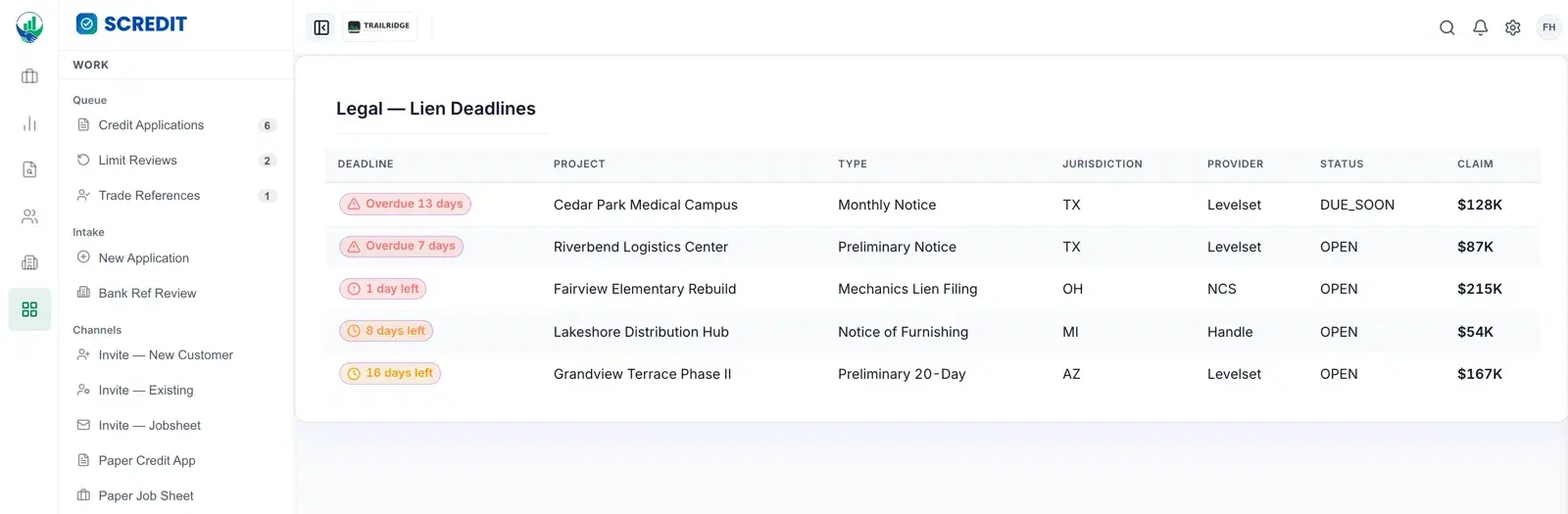
Notice and last-furnishing dates are tracked per job rather than remembered. The deadline stops living in one long-tenured employee's head.
A Deadline That Comes Looking For You
An approaching notice date, a missing preliminary notice or a lien right at risk raises an alert and opens a job exception on a nightly sweep. Statutes do not forgive near misses, so the date does not wait to be noticed.
Job Feeds That Cannot Double-Post
When job data arrives from a project system or a notice service, a repeated message is recognised as the same event rather than creating a second job or a duplicate deadline.
Overrides That Leave a Reason
When someone overrides what the system worked out, the change will not save without a written reason recorded against it, with who and when.
Works With Your Filing Service
Inbound adapters for Levelset, NCS and Handle bring lien rights, deadlines and notice status onto the credit file, so it and the filing record agree, with the field mapping confirmed against your own vendor connection during implementation. Your provider files; SCREDIT holds the clock and the evidence.
Deadlines, in the product
What changes on the desk
The Deadline Is Not One Person's Memory
Notice dates live in the system, so a resignation or a holiday does not put lien rights at risk.
Exposure That Matches How the Work Is Actually Sold
Job-level visibility rather than one customer balance covering a dozen sites.
A Defensible Record
Every notice date is held on the job with its type and status, and every override carries its written reason — the version that holds up when a claim is questioned.
Frequently asked questions
What is a job sheet in SCREDIT?
A job sheet captures the project-level information that construction credit depends on: the project, the customer relationship to it, and the details a credit team needs to assess and track job-linked exposure. It gives you a view of risk by project, not just by customer account.
Why is customer-level credit management not enough in construction?
Because payment in construction flows through a chain: owner to general contractor to subcontractor to supplier. A financially sound customer can still leave you unpaid on a troubled project. Managing exposure at the job level lets you see where your receivable actually sits in that chain.
Does SCREDIT file preliminary notices and liens for us?
No, and we are direct about that. SCREDIT is lien-aware, not a filing service: it tracks the jobs, documents and deadlines and works alongside Levelset, NCS or Handle rather than attempting to replicate fifty states of statutory mechanics in-house. Your provider performs the statutory filing; SCREDIT holds the clock and the evidence. If a single vendor performing the filing itself is what you need, that is a fair reason to choose differently.
Can we run standard trade credit and construction credit in the same platform?
Yes. Job sheets and project-linked exposure sit on top of the same application intake, scorecard decisioning, receivables, and collections workflows used for the rest of the portfolio, so a mixed book of contractor and non-contractor customers lives in one system.
How does job-level exposure change collections priority?
A balance tied to a job with an approaching lien deadline is a different problem from an ordinary late payment. Job-linked context lets collectors and credit managers weigh deadline sensitivity and project health when deciding what to work first, instead of sorting purely by days past due.
Explore SCREDIT construction credit workflows.
See how SCREDIT supports job-linked credit visibility for construction-oriented suppliers and distributors.