Collections management built for accountability and action.
SCREDIT helps collections teams prioritize overdue accounts, manage follow-up activity, track promises to pay, and improve coordination across collectors and stakeholders.
What is B2B collections software?
B2B collections software organises the pursuit of overdue trade receivables. It groups accounts into prioritised work queues, records each contact and its outcome, tracks promises to pay against what actually arrives, and separates disputed balances so the undisputed part of an invoice stays collectible.
Collectors need more than aging buckets.
Collections performance improves when teams know where to focus, why a balance matters, what happened previously, and what action should happen next. SCREDIT helps create that operational clarity.
What SCREDIT delivers
Prioritized Work Queues
Organize collector effort by aging, risk, and exposure context.
Promise-to-Pay Tracking
Track commitments and improve follow-up accountability.
Communication Visibility
Maintain a stronger history of outreach, notes, and action flow.
Queues That Reprioritize Themselves
When an account crosses a risk threshold, its place in the queue moves with it — the signal and the work order are one event.
The collections desk, in the product
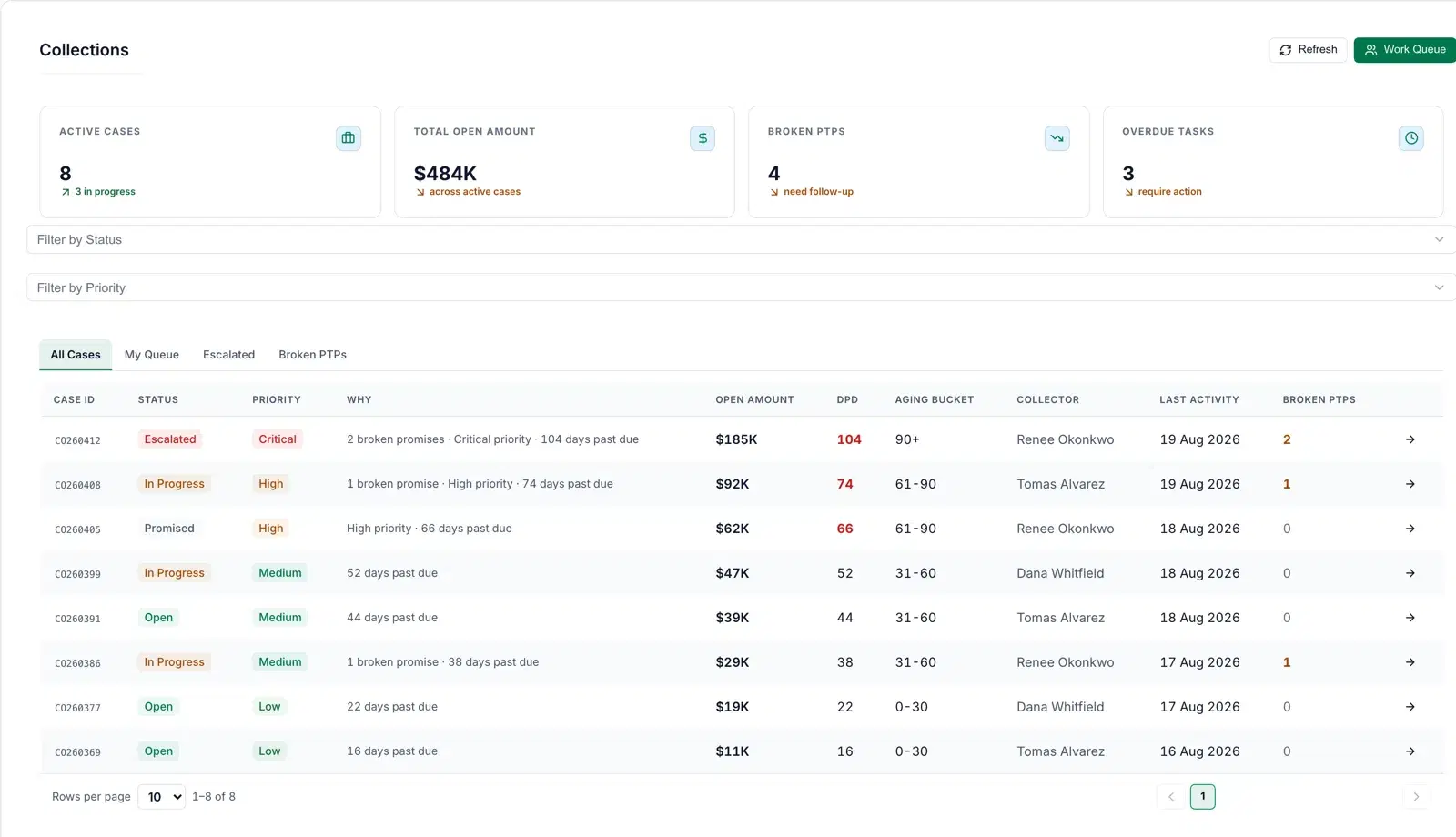
What changes on the desk
Higher Collector Productivity
Help teams focus time on the right accounts at the right time.
Improved Follow-Up Execution
Create more consistent action across overdue portfolios.
Better Team Transparency
Give managers clearer visibility into collector activity and progress.
Frequently asked questions
How do work queues get assigned to collectors?
Accounts are assigned to collectors through configurable queues, and managers can see and rebalance workload across the team. Each collector works a prioritized list with the account context attached: balance, aging, risk, disputes, prior contact history, and open promises.
What happens when a customer disputes an invoice mid-collection?
The dispute is logged against the specific invoice with a categorized reason and an owner, and the disputed amount is separated from the collectible balance. Collectors keep working the undisputed portion instead of pausing the whole account, and the dispute follows its own resolution track.
How does promise-to-pay tracking work in practice?
When a customer commits to a payment, the collector records the promise with an amount and date. SCREDIT tracks whether it was kept, which feeds both follow-up (broken promises resurface for action) and judgment (a pattern of broken promises is a risk signal, not just a collections annoyance).
Can managers see what the team actually did, not just what is outstanding?
Yes. Activity, notes, promises, and outcomes are recorded against accounts, so managers can review collector effort and progress rather than inferring it from balance movement alone.
What happens when an account's risk changes while a collector is working it?
The queue changes with it. Crossing into a watchlist — exposure past a threshold, a bureau score drop, a broken promise pattern — can move the account up the priority order, change who works it, or open a credit alert carrying an owner and an acknowledgment deadline. The point is that the risk signal and the operational response are the same event, rather than two systems a person has to connect. Each change is recorded with the rule that caused it.
Does SCREDIT send dunning communications automatically?
SCREDIT structures and tracks outreach as part of the collections workflow, and the SCONNECT customer portal gives customers self-service access to their invoices and statements, which removes a large share of resend-the-invoice back-and-forth. It is a collections execution platform, not a bulk email tool.
See collections in action with SCREDIT.
Explore how SCREDIT helps collections teams work with stronger prioritization, consistency, and accountability.