Credit decisions that are consistent, explainable, and fast.
SCREDIT combines weighted scorecard scoring, configurable risk bands, and policy-driven approval routing so every application gets the same disciplined evaluation, and every decision can be explained afterward.
What is credit decisioning software?
Credit decisioning software turns a written credit policy into a repeatable decision. It scores an applicant against defined components and weights, places the result in a risk band, and routes the decision to whoever holds the authority to approve it at that size, so the same application produces the same answer regardless of which analyst opens it.
When decisioning lives in individual judgment, consistency leaves with the person.
Two analysts, two answers. Approval authority enforced by memory. Decisions that cannot be reconstructed six months later. Judgment matters in credit, but without a scoring and routing framework around it, outcomes depend on who happened to pick up the file.
What SCREDIT delivers
Weighted Scorecard Engine
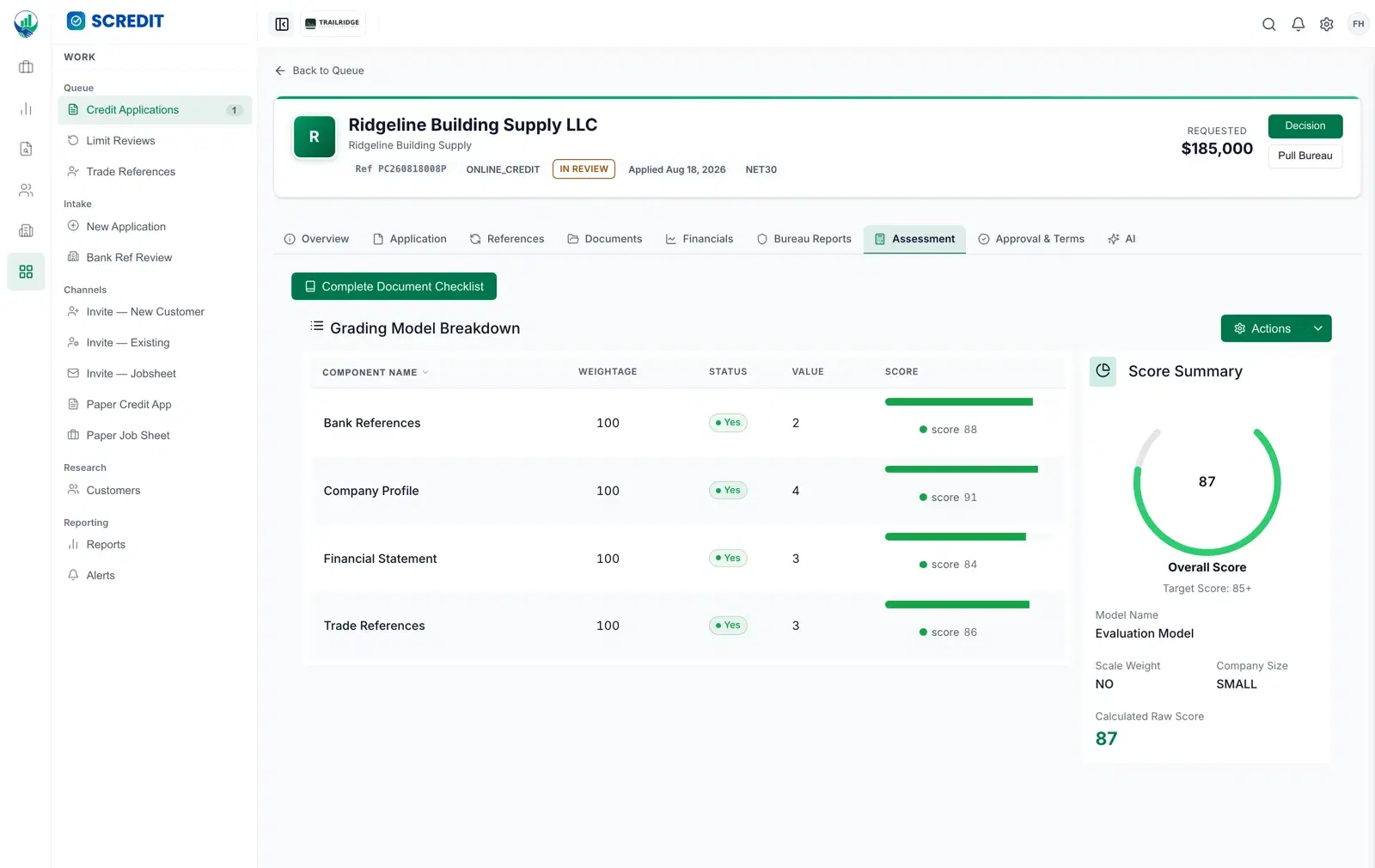
Score applications and accounts on weighted components spanning financials, payment behavior, and bureau data, with weights you configure to match your policy.
Weighting That Fits the Customer
A small trading account and a large one should not be judged on the same emphasis. Set different component weightings for small, mid-market, and large customers so the same policy reads each fairly.
Different Policies Under One Roof
Run more than one scorecard across the organisation. A subsidiary, a region, or a newly acquired business can carry its own components and weights while the group still sees one consolidated view of exposure.
Configurable Risk Bands
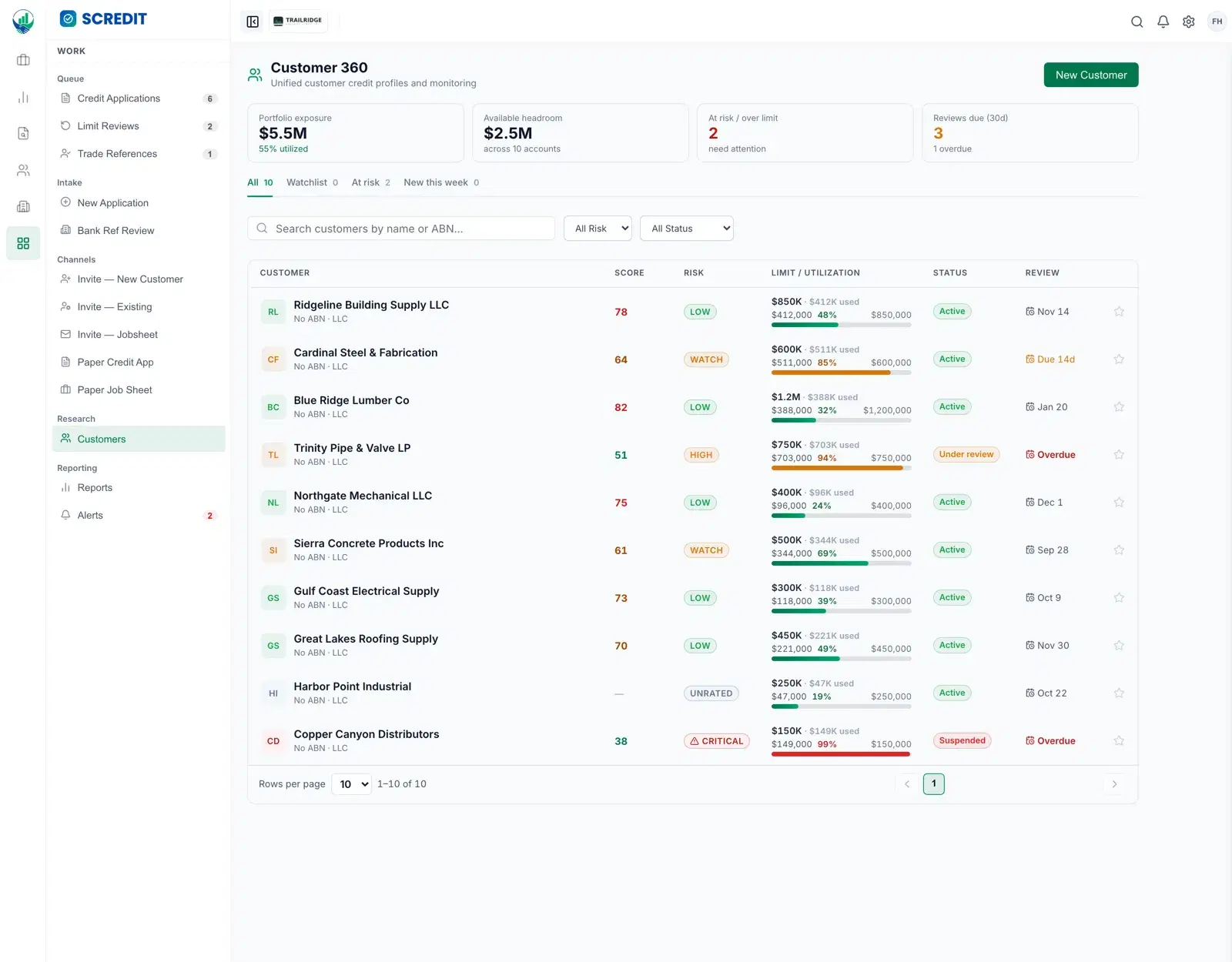
Map scores to named risk bands that drive limits, terms guidance, and review frequency consistently across the portfolio.
Approval Authority Thresholds
Define who can approve what by exposure and risk level, and let the system route each decision to the right level automatically.
Bureau Data in the Decision
Pull commercial bureau data into the scoring and review workflow so external signals sit beside your internal experience.
Financial Analysis Integration
Feed ratio and trend results from financial statement analysis directly into scorecard components.
Decision Audit Trail
Record what was scored, what the score was, who approved it, and under what authority, for every decision.
Decisioning, in the product
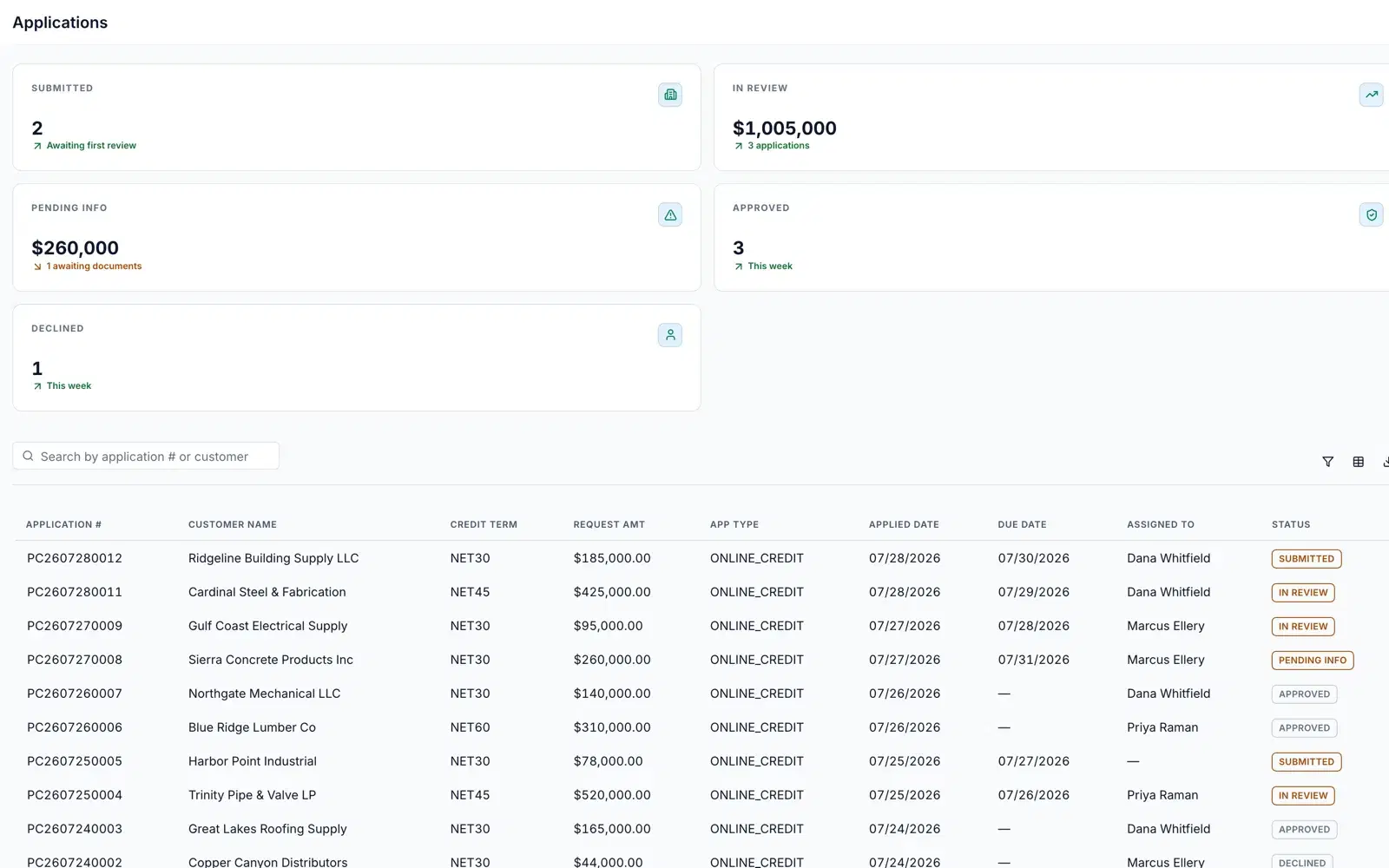
What changes on the desk
Consistent Decisions at Scale
Apply the same evaluation logic to the hundredth application as to the first.
Same-Day Movement on Scored Applications
Let clean applications flow to the right approver without waiting in an inbox.
Explainable Outcomes
Reconstruct any decision from its scored components and approval record.
Policy That Actually Executes
Turn the credit policy document into enforced workflow rather than aspiration.
Frequently asked questions
How does the weighted scorecard work?
You define the components that matter to your book, such as financial ratios, payment history, and bureau signals, assign each a weight, and define how raw values map to component scores. SCREDIT computes a weighted overall score and places the account in a risk band. The math is transparent: you can always see which components drove a score.
Can we configure the scorecard to our own policy, or is it a black box?
It is fully configurable and deliberately not a black box. Weights, components, thresholds, and risk bands are yours to define, and every score decomposes into its inputs. For trade credit, an explainable scorecard your team trusts beats an opaque model nobody can defend to an auditor or a sales VP.
How does approval routing use authority thresholds?
You define authority levels, for example what a credit analyst, credit manager, and finance director can each approve, by exposure amount and risk band. When a decision is ready, SCREDIT routes it to the right level of authority. Nothing gets approved above someone's authority, and nothing waits on a director that a manager could sign.
Does decisioning replace analyst judgment?
No. The scorecard produces a consistent, evidence-based starting point, and routing ensures the right person makes the call. Analysts and approvers still exercise judgment, especially on marginal scores and large exposures, but they do it on top of structured evidence.
How is this different from the credit score a bureau website gives us?
A bureau score is one input about one company from one vendor. SCREDIT decisioning combines bureau data with your financial analysis and your own receivables experience, weights them by your policy, and wraps the result in approval governance. The bureau tells you about the customer; the scorecard tells you what your policy says to do about them.
What happens when a customer's situation changes after approval?
Decisioning is not only for new accounts. Scores recalculate as inputs change, and risk bands drive review scheduling, so a deteriorating account surfaces for re-review rather than coasting on a limit approved in better times.
We operate several businesses with different credit appetites. Can they run different policies?
Yes. Scorecards are defined per business rather than per platform, so a distribution arm and a construction supply arm can weight components differently, use different risk bands, and set different approval authorities, while group-level reporting still rolls exposure up across all of them. Acquisitions are the common case: the acquired business keeps operating on its own policy while it is brought onto yours, rather than being forced onto day one.
Does the same scorecard apply to a $50k customer and a $5M one?
Only if you want it to. Component weighting can vary by customer size, so the emphasis that makes sense for a small trading account is not forced onto a major one. A thin file on a small account might lean on trade references and payment history, while a large exposure leans harder on audited financials — same policy, appropriate emphasis.
See scorecard decisioning in SCREDIT.
Bring a sample of your current policy and see how it maps to scorecard weights, risk bands, and approval routing.