Who gets this application, and why.
SCREDIT routes each application to the team and the analyst who should own it, weighs who is actually loaded rather than who has the fewest files, and keeps a record of why it landed where it did.
What is credit work routing?
Credit work routing decides which analyst handles which credit file. It assigns incoming applications and review work by defined rules rather than by whoever is free, weighs each desk's load by the difficulty of what sits on it rather than the number of files, and records why a file landed where it did.
Work lands by habit, and nobody can say why.
Applications get picked up by whoever opens the queue first, or they go to the analyst who always handles that customer until the day they are on leave. Nobody can answer why a file sat for three days, or why one analyst is drowning while another is clear. The routing rule exists — it just lives in people's heads, so it cannot be reviewed, changed, or explained.
What SCREDIT delivers
Routing on Your Rules
Send work to the right desk by the things that actually decide ownership: customer, exposure band, region, product line, or risk rating. The rule is written down once instead of re-decided every morning.
Load Measured Honestly
An overdue file is not the same weight as one that arrived this morning, and a high-priority review is not the same as a routine one. Work distributes by real burden rather than a headcount split.
Why This Analyst
Every routing decision keeps the rule that fired and the candidates that were considered. When someone asks why they got the file — or why they did not — there is an answer on the record.
Rebalancing When a Desk Drifts
When one analyst pulls well ahead of the queue, work can move rather than waiting for someone to notice. You set how far apart the desks have to get before anything shifts.
Routing on Submission
An application that arrives complete does not wait to be triaged before it starts moving. Assignment happens on submit, so the clock starts on the work rather than on the inbox.
Changed Without a Release
Reorganise a team, add a region, change how heavily overdue work counts — these are settings, not a development request. The routing policy keeps up with the organisation.
The queue, in the product
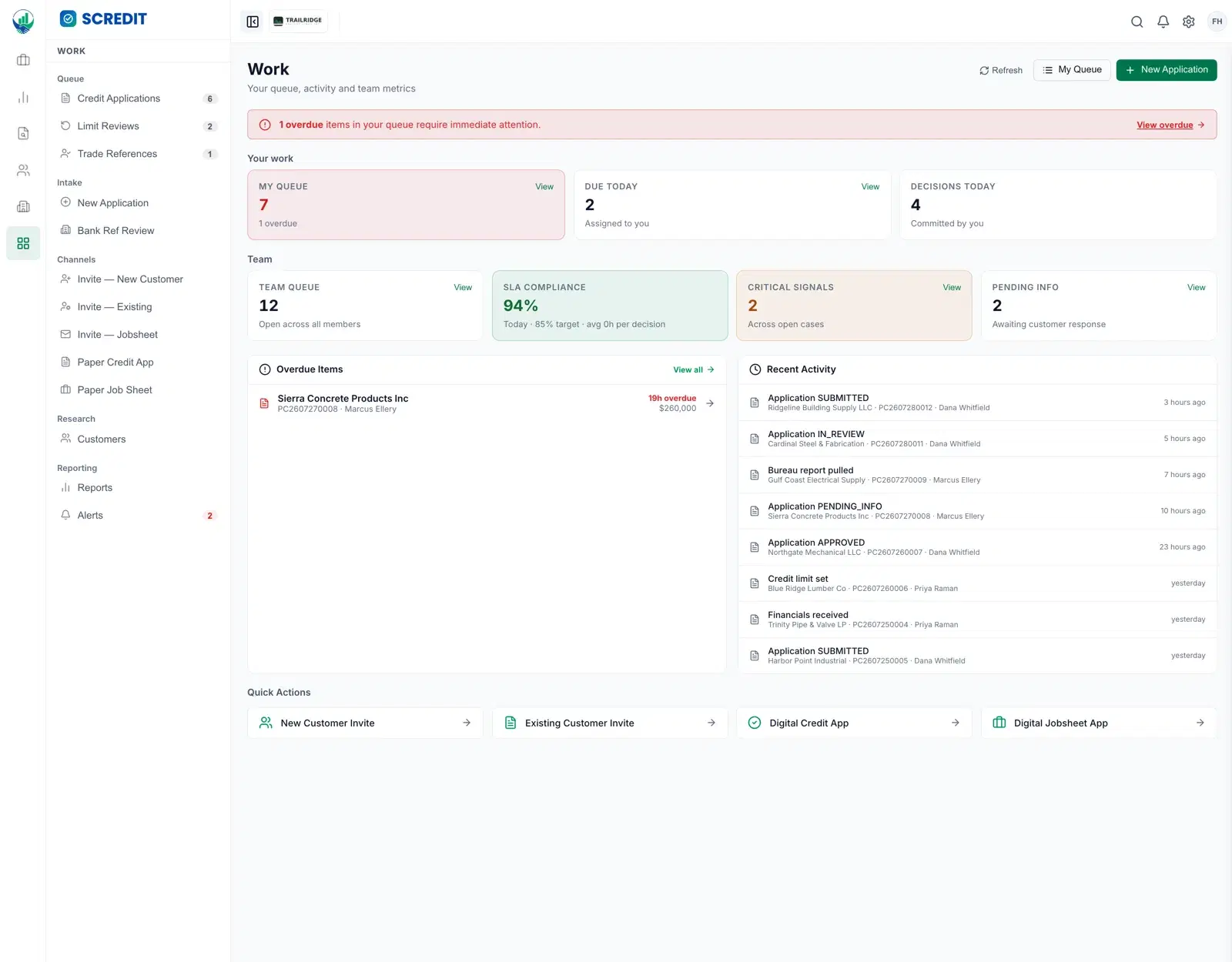
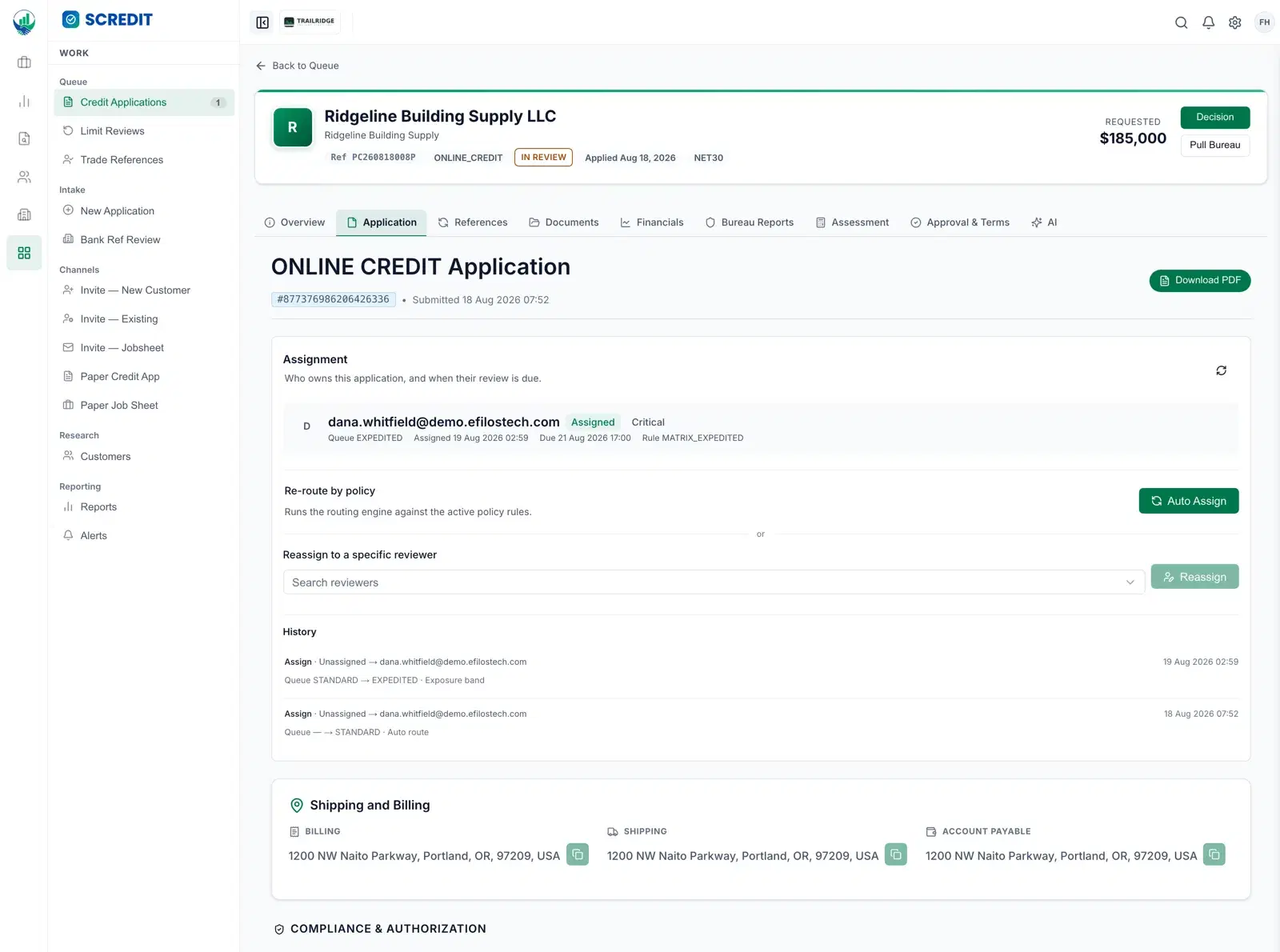
What changes on the desk
No File Waits for a Human Triage Step
Work is owned from the moment it arrives instead of sitting in a shared queue.
Load That Reflects Reality
Distribution accounts for overdue and high-priority work, not just how many files each person has open.
An Answer to "Why Me?"
Routing decisions are on the record, so ownership disputes are settled by the system rather than by seniority.
A Policy You Can Actually Change
When the team changes, the routing changes the same afternoon.
Frequently asked questions
How is this different from a shared queue everyone picks from?
A shared queue optimises for whoever is fastest to click, which is not the same as whoever should own the file. Routing assigns ownership up front using your rules, so the customer with a $2M exposure does not get picked up by whoever happened to be free, and no file sits unclaimed because everyone assumed someone else had it.
What stops routing from overloading one analyst?
Load is measured before work is placed, and not simply by counting open files. Overdue and high-priority items count for more than routine ones, because they cost more attention. If a desk still drifts ahead, a rebalance can move work — and you set how large the gap has to be before that happens, so the system is not reshuffling ownership every hour.
Can an analyst or manager override where something went?
Yes. Routing produces a starting point, not a cage. A manager can reassign, and the reassignment is recorded alongside the original routing decision, so the history shows both what the policy said and what a human decided instead.
What happens when someone is on leave or leaves the company?
Because ownership is expressed as a policy rather than a habit, work stops depending on a specific person being present. Team membership changes take effect on the next routing decision, and existing work can be rebalanced across the remaining desks instead of sitting in an inbox nobody is reading.
Do we need development help to change how work is routed?
No. The routing policy and the weightings behind it are configuration, held in the system and changed by an administrator. Reorganising desks, adding a region, or deciding overdue work should count more heavily are all same-day changes, not release-cycle changes.
Does routing apply to collections work as well as new applications?
The same principle applies wherever work has to be owned by someone: assignment is recorded, load is accounted for, and the reason is kept. New credit applications are the clearest case because the clock starts the moment one is submitted.
See how work would route in your credit team.
Bring how your desks are split today — by customer, region, or exposure — and see it expressed as a routing policy, including what happens when someone is on leave.